As hotels enter 2026 with stable demand but rising costs, the industry is facing a harder truth: performance now depends as much on workforce visibility, retention and smarter hiring as it does on occupancy.
For hotel owners, 2026 is shaping up as a year of contradiction. Demand is not collapsing. Travel has not disappeared. Guests are still moving, events are still filling calendars, and many operators expect the year to be broadly stable. Yet beneath that stability, the economics of running a hotel are becoming harder to manage.
A March 2026 survey from the American Hotel & Lodging Association makes that tension clear. Hotel owners and operators are not only watching demand. They are watching the cost of goods, labor expenses, utilities, insurance premiums, and workforce shortages compress the space between revenue and profitability. In the survey, 71% of respondents cited the cost of goods and supplies as a major financial pressure, 65% pointed to labor costs, 59% mentioned fluctuating demand and occupancy, 50% cited utility and energy costs, 43% pointed to insurance premiums, and 42% named workforce shortages.
The important point is not that one cost line has become difficult. The important point is that all of these pressures are arriving at the same time. A hotel can absorb a single challenge when demand is strong. It is far harder to absorb higher wages, higher supply costs, higher energy bills, higher insurance premiums and inconsistent booking patterns while also trying to maintain service standards with teams that remain stretched.
This is why the staffing conversation in hospitality needs to move beyond the familiar language of shortage. The issue is no longer only that hotels need more people. The issue is that hotels need the right people, in the right roles, with the right information available to managers before and after hiring. When labor costs are one of the largest pressures facing owners, every hiring decision becomes more consequential. A weak match is not just an HR inconvenience. It becomes an operational cost.
The AHLA survey found that more than half of respondents said their properties were somewhat or severely understaffed. To compete for talent, hotels are already adjusting their offers. Many are raising wages, with 70% of respondents saying they are offering higher pay. Others are using flexible scheduling, hotel discounts and enhanced benefits to attract and retain employees. These incentives matter, and they reflect a market where talent has more expectations and more alternatives than before.
But incentives alone do not fix the structural problem. Higher wages may help bring people through the door, but they do not automatically improve role fit. Flexible scheduling may improve retention, but it does not solve poor onboarding. Benefits can make an employer more attractive, but they do not replace a clear view of a candidate’s skills, service mindset, mobility, goals and suitability for a specific property environment. The industry cannot rely only on paying more if the underlying hiring process remains slow, fragmented, and CV-driven.
The broader labor data supports the same conclusion. National Restaurant Association analysis of April 2026 labor data showed that accommodation and foodservice businesses continued to seek workers at a healthy pace, with job openings averaging 855,000 over the previous 12 months. At the same time, hires softened in April, and separations slightly exceeded hires. The sector is not frozen, but it is not frictionless either. People are still entering and leaving roles at a scale that forces employers to treat workforce planning as an ongoing system rather than a reactive process.
The quit rate also remains relevant. Federal Reserve Economic Data, based on U.S. Bureau of Labor Statistics JOLTS data, showed the accommodation and food services quit rate at 4.0% in April 2026. That does not mean the labor market looks exactly like the peak Great Resignation period, but it does show that turnover pressure is still part of the operating reality for hospitality. In an industry where every departure can affect service consistency, team morale and manager workload, retention has to begin before the employee’s first shift.
That is where many hotel companies still have a gap. Recruitment, onboarding, scheduling, training, and retention are often treated as separate processes. A candidate applies through one system, is screened manually, interviewed through a chain of emails, onboarded through another workflow and then managed through departmental routines that may not connect back to the original hiring information. By the time a new employee starts, the signals that could help a manager support them are often scattered or lost.
This is especially risky when demand is steady, but margins are under pressure. A hotel that expects occupancy to hold cannot assume profitability will follow. Stable demand does not cancel out cost inflation. Strong event calendars do not eliminate staffing gaps. Even major demand opportunities can be uneven. AHLA noted that with the 2026 FIFA World Cup scheduled across the United States, many hotels were monitoring early booking trends, and nearly 20% of applicable properties reported bookings below expectations at the time of the survey. The lesson is clear: hotels cannot build their workforce strategy around perfect demand conditions.
This also has implications beyond the United States. WTTC has warned that travel and tourism is projected to generate 91 million new roles by 2035, but global demand for workers could outpace supply by more than 43 million people. For hospitality specifically, the projected gap is 8.6 million workers. In Europe, CBRE’s 2026 hotel outlook points to measured growth, disciplined supply and a shifting demand pool, with international business travel and long-haul inbound demand supporting the sector. Yet even in healthier demand environments, operators still face the same fundamental question: how do they staff, develop and retain teams when talent supply is not guaranteed?
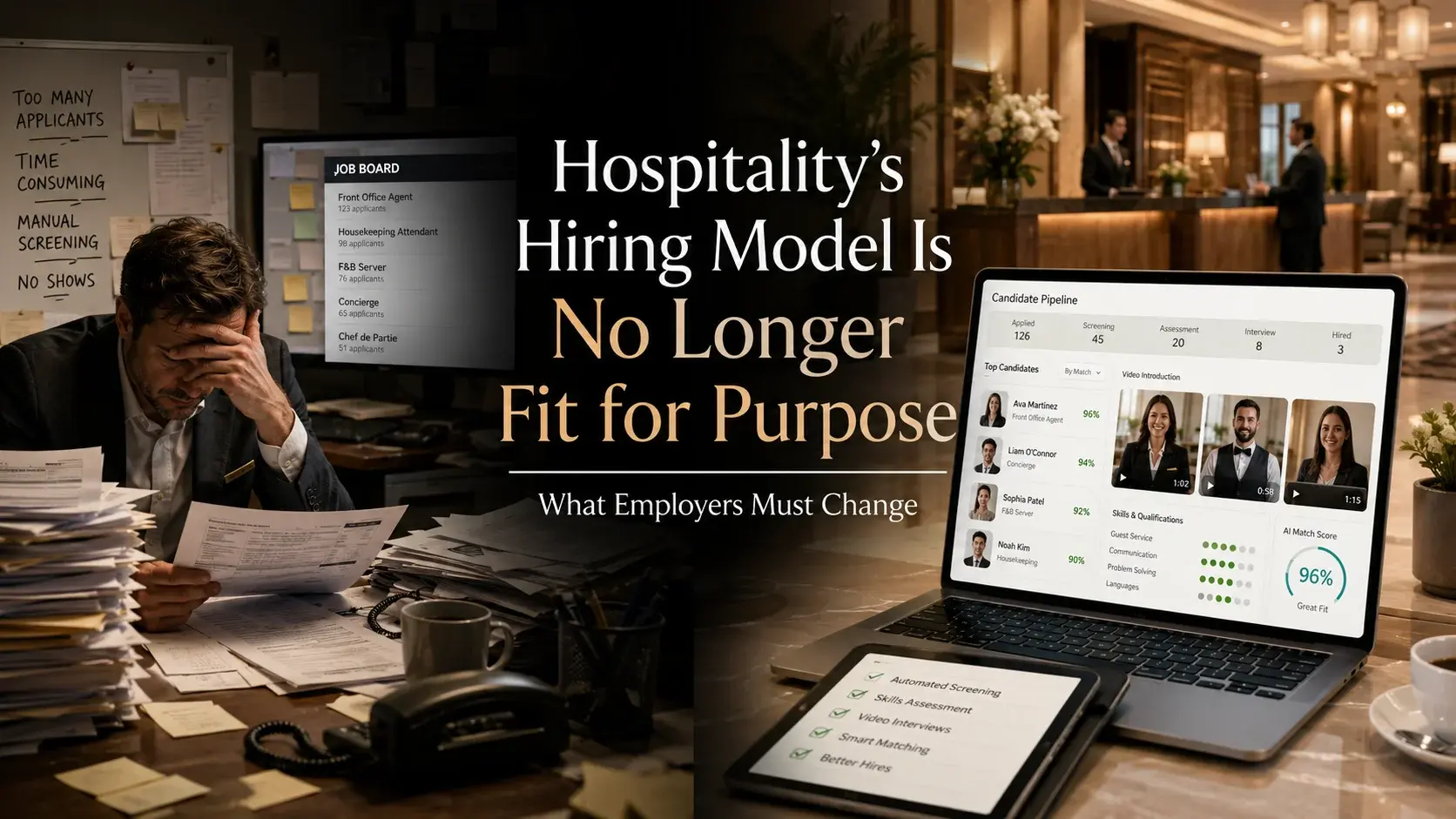
The answer is not simply to post more jobs. It is to make the talent funnel more intelligent. Hospitality employers need better visibility into who is available, who is relevant, who has the skills required for a specific role, and who is likely to succeed in the environment of a particular hotel, restaurant or group. They need faster ways to separate unsuitable applications from strong candidates. They need hiring workflows that reduce manual screening without removing human judgment. They need onboarding that builds on what is already known about the candidate instead of starting from zero.
This is where workforce technology can create real value if it is used for the right purpose. Technology should not make hospitality less human. It should make the hiring process less blind. It should help managers make better decisions faster, while giving candidates a clearer, fairer and more professional journey. In an industry built on service, the employee experience starts long before the first day of work. It starts with how a candidate is seen, assessed, communicated with, and matched to an opportunity.
The employers that stand out in this environment will not be the ones that only offer slightly higher wages. They will be the ones who combine competitive offers with clarity, speed, development, and operational discipline. They will understand that employer attractiveness is not a slogan. It is the total experience a candidate and employee have with the business, from the first application to career progression.
For years, hospitality could treat hiring as a function that reacted to vacancies. That model is becoming too expensive. When labor costs, supply costs, and service expectations rise together, the workforce becomes a strategic asset that must be measured, managed, and improved continuously. A property that can see its talent pipeline clearly has a better chance of controlling costs, protecting service quality, and building a team that stays.
The AHLA survey is therefore not just a warning about costs. It is a signal that the operating model of hospitality is changing. Stable demand may keep rooms occupied, but it will not solve staffing pressure. Higher rates may support revenue, but they will not guarantee service consistency. Incentives may attract applicants, but they will not ensure a fit.
Hospitality’s next advantage will come from knowing its workforce better. Not just how many people applied, but who they are, what they can do, where they fit and how they can grow. In a market where every cost line matters, that visibility is no longer optional. It is becoming one of the clearest differences between hotels that keep reacting to pressure and hotels that are prepared to manage it.
Sources
- American Hotel & Lodging Association, “Rising Cost, Staffing Challenges Persist for Hotels as Travel Demand Expected to Hold Steady,” March 17, 2026. [link]
- National Restaurant Association, “Restaurant Job Openings and Labor Indicators,” June 2026. [link]
- Federal Reserve Bank of St. Louis (FRED), “Quits: Accommodation and Food Services,” based on U.S. Bureau of Labor Statistics JOLTS data, updated June 2, 2026. [link]
- World Travel & Tourism Council, “Travel & Tourism Set to Support 91MN New Jobs by 2035,” September 30, 2025. [link]
- Hotel Dive, “Hospitality Industry Could Face 8.6M Workforce Shortfall by 2035: WTTC,” October 9, 2025. [link]
- CBRE, “European Hotels Real Estate Outlook 2026.” [link]
- Hotel Dive, “A Pulse Check on U.S. Hotel Performance in a Challenged Economy,” October 9, 2025. [link]