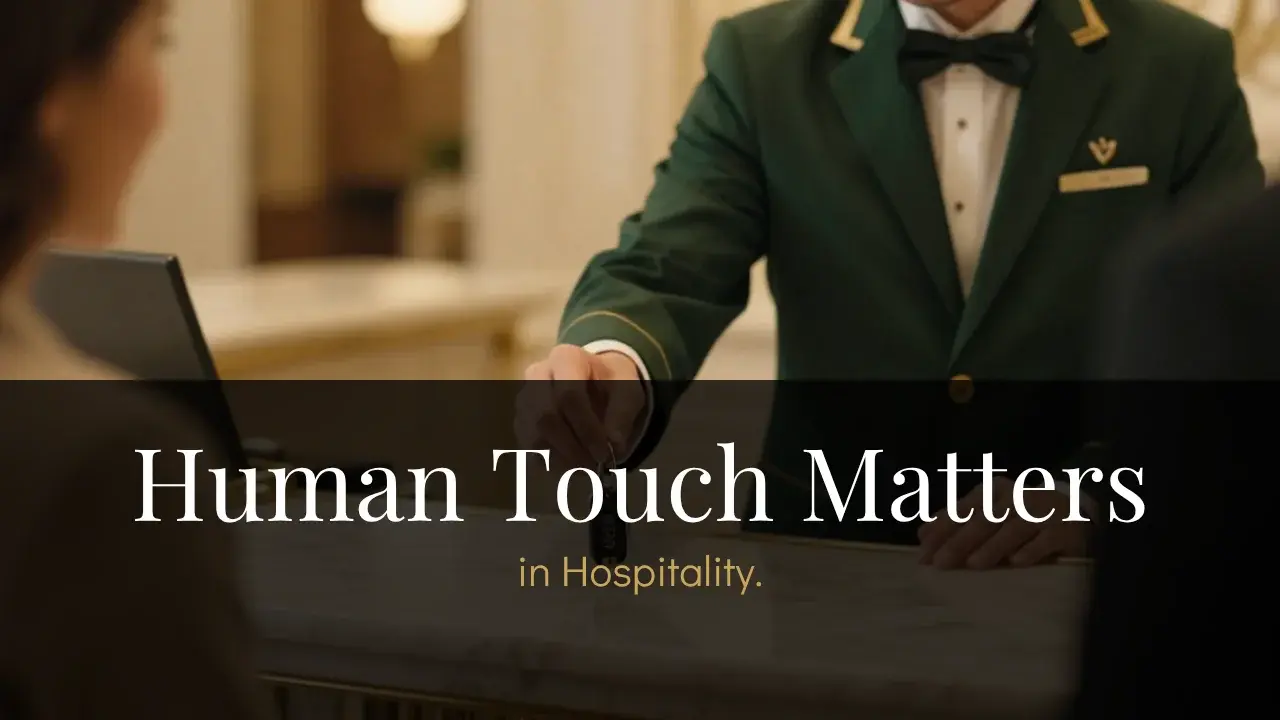
Hospitality is having a loud, visible conversation about artificial intelligence — humanoid robots at check-in, chatbots fielding guest questions, automation reshaping the front of house. That conversation matters. But for independent hotels, argues Mats Persson, co-founder and chief executive of booking-software firm Sirvoy, the higher-stakes question sits out of sight: when automated systems collide, create ambiguity or fail in unexpected ways, who catches it before the guest does? Consumer research increasingly suggests the worry is well founded.
The automation backlash is real
Frustration with AI-driven customer service is mounting across industries. Glance’s 2026 CX Trends Report, based on a national survey of more than 600 US consumers, found that three-quarters had been on the receiving end of a fast automated response that still left them frustrated, and that what people actually want is resolution, not speed.
What 10,000 support chats reveal
To test where the pressure really sits, Sirvoy analysed more than 10,000 live-chat support conversations from independent accommodation businesses in 2025, looking specifically at the moments operators reached for human help. The pattern that emerged is not resistance to automation but anxiety about what happens when it breaks.
In many cases, operators weren’t reaching out because they didn’t know how to do something — they reached out because the stakes felt high. A guest disputing a charge, a payment that looks wrong, availability that doesn’t line up across channels: in each, the operator wants confirmation they haven’t made a mistake before the guest notices. Across the transcripts, the language of uncertainty recurs — afraid, worried, confused — usually followed by relief once a human confirms everything is actually fine. The value in those moments, Persson notes, is neither speed nor warmth. It is confidence, and confidence is what decides whether a problem stays behind the scenes or reaches the guest.
The problem usually lies between the systems
That anxiety sharpens when an issue spans more than one platform. A single booking can pass through an online travel agency, a channel manager, a payment processor and the property’s own management system. When something goes wrong, operators frequently can’t tell which system owns the problem, and automation inside any one tool is no help if the fault sits in the space between them.
The most valuable person in that moment, Persson contends, is not the one greeting the guest but the one who can see across system boundaries and say, in effect, “You didn’t break anything” - here is what is actually happening. It also explains why earlier bad experiences shape expectations: operators already worn down by self-service tools, and bounced between help centres and automated replies, come to value genuine human support precisely because it contrasts with all of that.
Rethinking where automation adds value
None of this is an argument against automation. Independent hotels rely on it to survive — tools that handle routine tasks, manage data and cut administrative load are essential. But the data suggests the industry may be overestimating where automation adds the most value. The real question, in Persson’s framing, is not whether guests will accept AI at reception; it is whether operators have a reliable safety net when automation creates uncertainty behind the scenes.
As hospitality moves deeper into 2026, the conversation may need to shift — not away from AI, but toward how technology supports human judgment when it matters most. On this view, the systems that win will not be the ones that remove people from the loop entirely, but the ones that make sure a human is reachable when confidence, clarity, and accountability are on the line.
Sources
• Glance — 2026 CX Trends Report (national survey of 600+ US consumers)
• Sirvoy — analysis of 10,000+ independent-accommodation live-chat support conversations, 2025
• Adapted from a guest opinion by Mats Persson, co-founder and CEO of Sirvoy, published by Hotel Dive (April 2026)