The hospitality industry is fully employed again on paper, but still cannot keep its teams. By March 2025, the leisure and hospitality sector had finally surpassed its February 2020 peak, reaching roughly 16.99 million jobs, according to the U.S. Bureau of Labor Statistics. Underneath that headline, the workforce is churning at a rate no other sector tolerates: the number of people who quit hospitality jobs in 2024 ran about 204 percent above the national average quit rate, and annual turnover across the industry still sits between 70 and 80 percent.
The recovery has also been deeply uneven. Arts, entertainment, and recreation have added nearly 200,000 jobs beyond their pre-pandemic peak. Accommodation and food services, restaurants and hotels, remain close to 100,000 jobs short. The strain shows up most sharply in hotels, where 67 percent of operators report staffing shortages and around 12 percent describe themselves as so severely understaffed that it threatens their ability to operate (AHLA). Restaurants report understaffing at 45 percent; travel agencies at 19 percent. And cruise lines, tellingly, report the opposite problem, roughly 100 applicants for every onboard opening and retention above 80 percent, proof that the labour pool exists when the offer is right.
Pay has moved, and it has not been enough. Average hourly earnings in leisure and hospitality climbed from $16.84 in January 2020 to $22.53 in January 2025, outpacing inflation by roughly 8.6 percent. Yet the same operators raising wages are the ones reporting that labour cost is now their single biggest challenge. Wage inflation is buying survival, not stability.
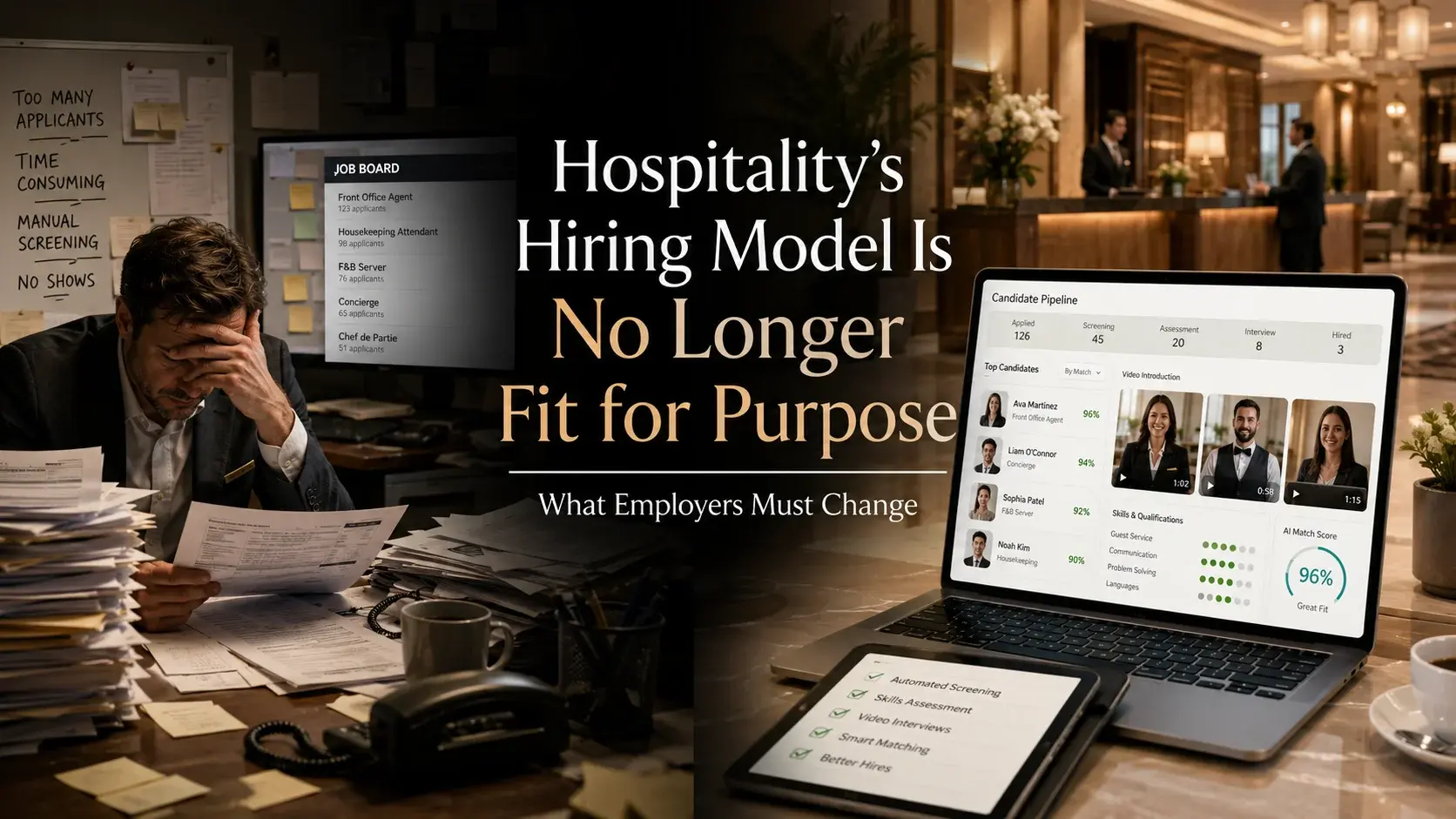
The conclusion is uncomfortable but clear: the old hiring model- post a job, screen a CV, win on wage - is structurally broken. To attract and retain the people who define the guest experience, employers must rebuild hiring around what today’s workforce actually responds to, delivered faster and more humanely than the competition.
Four things that must change
1. Stop competing on pay alone, but rather on culture and experience
When the Society for Human Resource Management asked the operators who reported little to no difficulty hiring what set them apart, pay was not at the top of the list. A positive workplace culture and a competitive benefits package tied for first at 59 percent each. Competitive pay followed at 54 percent, flexible work arrangements at 53 percent, and a strong employer reputation at 48 percent.
Read that order carefully. Four of the five differentiators that distinguish employers who can staff from those who cannot are things money cannot directly buy. Pay must be credible, but it is now table stakes. The advantage lies in culture, benefits, flexibility, and reputation. The parts of the offer most operators still treat as soft.
What must change: audit your offer the way a candidate does. If your only lever is hourly rate, you are competing in the one arena where you can always be outbid.
2. Fix the hiring process for how people actually apply
Roughly half of current and near-future hospitality applicants are Gen Z, and they have rewritten the rules of application. The majority, 86 percent, apply from a mobile device, and 54 percent apply outside standard business hours. A hiring funnel built for desktop forms and next-business-day callbacks is invisible to most of the people it needs to reach. Speed compounds the problem: in a market this tight, the employer who responds first usually wins the hire.
The technology to fix this exists, and the gap is in execution, not availability. Southern Rock Restaurants, operating 160 franchised stores, used applicant-tracking automation and automatic interview scheduling to cut time-to-hire from 14 days to under 24 hours, which is a 93 percent reduction. Yet across the sector, while 80 percent of operators believe technology gives them a competitive hiring advantage, only 15 percent say it has actually made it easier to recruit and retain staff. The tools are bought but not implemented.
What must change: treat hiring technology as an operational discipline, not a purchase. An ATS that nobody configures is a cost, not an advantage.
3. Treat development as recruitment, not a perk
The clearest unexploited advantage in hospitality hiring is career development, because the demand is overwhelming and the supply is thin. Around 65 percent of prospective employees say development opportunities matter when choosing a job, yet only 47 percent of employers offer education perks such as tuition assistance or training pathways. That is a differentiation gap hiding in plain sight.
The retention math is just as strong. Among workers offered education benefits, 93 percent say employer perks influence whether they take a job, 84 percent call them a major factor in accepting an offer, and 76 percent say they are more likely to stay with an employer who provides them. Education benefits have been associated with turnover reductions of roughly 20 to 40 percent, extraordinary leverage in an industry where 70-to-80 percent churn is normal.
What must change: reframe training and education from a line-item perk into your primary retention engine. In a sector this transient, “a career, not a job” is the most persuasive thing you can offer.
4. Build flexibility and well-being into the model, not around it
Understaffing is not only a hiring problem; it is a self-perpetuating one. Burnout and turnover, reduced service levels, longer wait times and higher error rates ripple out from every unfilled shift, degrading both the employee experience and the guest experience that drives reviews and revenue. Each departure makes the remaining roster harder to retain.
The workforce composition makes flexibility non-negotiable. About 27 percent of food and beverage employees are enrolled in school while working, compared with just 10 percent of the overall workforce. Rigid scheduling does not merely inconvenience these workers. It pushes them out. The operators pulling ahead are designing flexible scheduling, predictable hours, and well-being safeguards into the job itself, and pairing them with consistent manager feedback; employees who receive regular feedback are 3.6 times more likely to be motivated to do outstanding work than those who hear from a manager once a year.
What must change: stop treating flexibility and well-being as concessions granted to good performers. They are the operating conditions under which a modern hospitality team can be retained at all.
The cost of standing still
None of this is theoretical. The employers who keep relying on wage increases and CV screening are not holding steady; they are falling behind a workforce that has already moved on, while absorbing the compounding costs of every empty shift. The cruise sector’s queue of applicants is a reminder that the talent is out there; it goes to the employers who have built an offer worth staying for.
Fixing hospitality hiring requires a fundamental shift in how talent is attracted, developed, and supported. Pay must be competitive, but the decisive levers are culture, a hiring process that meets candidates where they are, development that turns a job into a career, and flexibility that respects the lives people actually lead. As the industry continues to expand against a tightening labour market, the operators who modernise their approach now will be the ones building stable, motivated, service-ready teams while their competitors are still rewriting the same job ad.
Sources
• U.S. Bureau of Labor Statistics — employment and quit-rate data, leisure and hospitality
• American Hotel & Lodging Association (AHLA) — hotel staffing-shortage survey
• National Restaurant Association — restaurant labour and workforce-technology research
• Society for Human Resource Management (SHRM) — 2024 Talent Trends research
• Cruise Lines International Association — onboard hiring and retention data
• Gallup; Instride — education-benefit and manager-feedback research