Demand may be stabilizing, but labor stability is now shaping service quality, brand standards and long-term hotel value.
For years, hotel labor was treated as a cycle. Demand rose, operators hired more people. Demand softened, payroll was adjusted. That model is becoming less reliable.
The latest reporting from Hotel Management, based on The Staffing Agency white paper The Hotel Workforce Reset: The Year Ahead 2026, makes the point clearly: labor is no longer a short-term staffing issue. It has become a structural force that affects execution, guest satisfaction, brand compliance and asset value.
|
65% of U.S. hotels report ongoing staffing shortages The shortage is visible even after wages have risen. |
4.0% quit rate in accommodation and food services Nearly double total private employment at 2.1% in April 2026. |
|
679k restaurant and lodging job openings in April 2026 Down from a 12-month average of 855k, but still a large market gap. |
8.6M projected global hospitality worker gap by 2035 A long-term supply issue, not only a short-term hiring problem. |
Taken together, the data shows a clear shift. Hotels are no longer managing labor only as a cost line. They are managing it as a performance constraint.
Labor is now an operating constraint
The headline number is difficult to ignore. According to the report covered by Hotel Management, 65% of U.S. hotels continue to report staffing shortages, even as wages have risen.
The same report notes that turnover remains elevated and that asset managers are increasingly watching payroll per occupied room rather than only payroll as a percentage of revenue. That shift matters. It shows that labor is being measured less as a generic cost line and more as a direct indicator of how efficiently a property can serve each guest night.
This is not simply a story about not having enough people. It is a story about whether the right people are in the right roles, whether they stay long enough to become productive, and whether managers have the visibility to plan around real staffing constraints instead of constantly reacting to them.
Demand stability does not remove workforce risk
The labor question is becoming more important precisely because demand has not collapsed. AHLA survey data from March 2026 shows that many hotel owners and operators expect travel demand to hold relatively steady or improve compared with 2025. Yet the same survey shows that costs and staffing remain major pressure points.
The most frequently cited financial pressures were goods and supplies at 71%, labor costs at 65%, demand and occupancy fluctuations at 59%, utility and energy costs at 50%, insurance premiums at 43%, and workforce shortages at 42%.
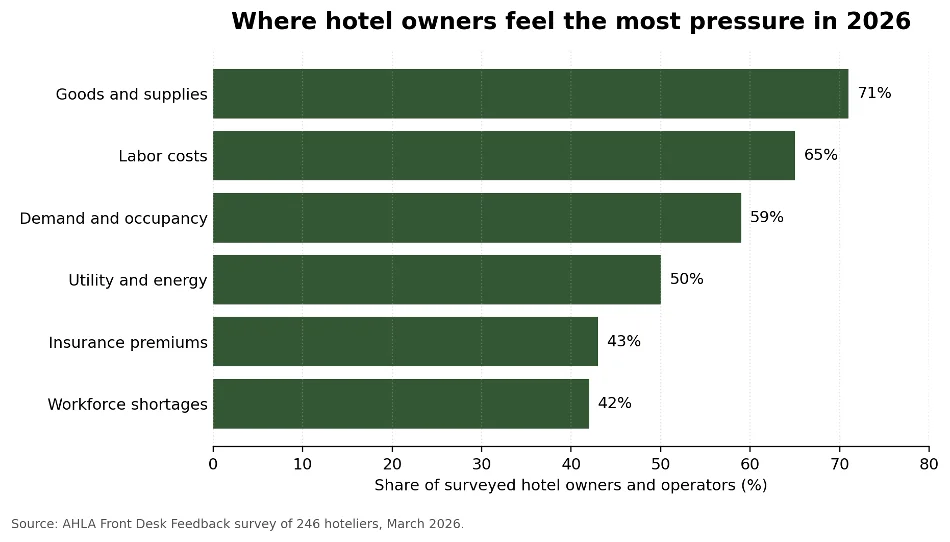
Figure 1: Financial pressures cited by hotel owners and operators in AHLA survey data.
More than half of AHLA survey respondents reported that their properties were somewhat or severely understaffed. Many are already responding with higher wages, flexible scheduling, hotel discounts, and enhanced benefits. Those incentives are important, but they also reveal a deeper truth: employers are no longer competing only on the job itself. They are competing on the total employment experience.
In a tighter margin environment, the cost of getting hiring wrong is rising. A vacant role affects service speed. A poor fit affects team morale. A weak onboarding process increases turnover risk. A missing supervisor can damage standards faster than a soft booking month. Labor has become the connection point between revenue, reputation, and operational control.
The quit rate still tells the story
Broader labor market data support this point. In April 2026, the BLS JOLTS table showed a 4.0% quit rate in accommodation and food services, compared with 2.1% for total private employment. Leisure and hospitality overall recorded a 3.7% quit rate.
The sector is no longer in the peak Great Resignation environment, but employee movement remains high enough to keep managers under constant pressure. That is why the conversation has to move beyond job postings and into retention, scheduling, and fit.
National Restaurant Association analysis of the same JOLTS data found that restaurant and lodging job openings fell to 679,000 in April 2026, while openings over the prior 12 months averaged 855,000.
That signals some stabilization compared with the extremely tight labor market of 2022, but it does not mean the problem has disappeared. It means the issue is shifting from pure shortage to quality, retention, and workforce design.
|
Long-term context WTTC projects a global hospitality worker gap of 8.6 million by 2035 if labor supply does not catch up with demand. This turns the quit-rate discussion into a future workforce planning issue. |
Hotels may be receiving applications again, but volume is not the same as fit. A property still needs to know who can perform the role, who understands the service environment, who can work the required schedule, who is likely to stay, and who should be developed into the next internal move. Those questions cannot be solved by job postings alone.
Every segment feels the pressure differently
The Hotel Management report highlights an important segmentation point. Extended-stay hotels are more resilient because their service models are often better aligned with leaner labor structures. Luxury hotels face a different challenge: higher guest expectations, more personalized service and acute shortages in skilled roles. Midscale hotels, meanwhile, operate with thinner margins, where labor instability can quickly show up in reviews, brand standards and guest satisfaction.
|
Segment |
Main labor pressure |
What operators need to see |
|
Extended stay |
Leaner teams and consistency across operating routines. |
Productivity, scheduling reliability and cross-trained staff. |
|
Luxury |
Higher service expectations and shortages in skilled roles. |
Service style, communication, languages and experience quality. |
|
Midscale |
Thinner margins where labor gaps show quickly in reviews. |
Fit, speed to productivity and manager visibility. |
Figure 4: Segment-specific labor pressure by operating model.
That distinction is important for owners and operators. There is no single labor strategy that works for every asset. A luxury resort does not have the same staffing model as an extended-stay property. A city-center select-service hotel does not need the same candidate profile as a destination property with multiple F&B outlets.
This is where the industry often falls short. Many hiring systems still treat hospitality roles as standardized vacancies. In reality, hotel roles are highly contextual. A candidate who performs well in one environment may not succeed in another. Employers need better ways to see beyond title, years of experience and a CV summary.
The winners will manage labor as a performance system
The most important message from the data is not that hotels need to hire faster. It is that hotels need to hire, retain and deploy people more intelligently. The report argues that retention, supervisor stability, and flexible staffing models now deliver higher returns than aggressive hiring alone. That is a major shift in how hotel labor should be managed.
|
Old labor view |
Performance-system view |
|
Time to fill |
Time to productivity |
|
Payroll as a cost line |
Payroll per occupied room |
|
Open roles |
90-day retention and manager stability |
|
Application volume |
Candidate fit and quality of match |
|
Reactive replacement hiring |
Internal mobility and future skill planning |
Figure 5: The metric shift from vacancy filling to workforce performance.
The strongest operators will look at labor as a performance system. They will track time to fill, but also time to productivity. They will track payroll, but also payroll per occupied room. They will monitor open roles, but also 90-day retention, manager stability, service consistency, and review impact.
They will use technology not to remove the human side of hospitality, but to give managers better visibility before small staffing problems become operational failures.
This is also where AI and workforce intelligence can create practical value. The opportunity is not simply to automate recruiting tasks. It is to help hospitality employers understand talent more clearly: skills, availability, mobility, fit, communication style, experience level, and development potential. Better data can reduce unsuitable applications, shorten screening time, and help teams focus on candidates who are more likely to succeed in a specific property environment.
The industry does not need more noise in the hiring process. It needs clarity. It needs systems that connect sourcing, screening, ranking, interviewing, onboarding, and retention. It needs hiring data that supports human judgment rather than replacing it.
Hotel labor has become one of the defining factors of performance because service still depends on people. Demand can be stable. Brand standards can be strong. Technology can improve the back office. But if the team on property is understaffed, unstable, or poorly matched to the work, the guest experience will feel it.
The next operating cycle will reward hotels that are realistic about this. Labor is no longer a back-office problem. It is one of the most visible measures of whether a hotel can deliver what it promises.
Sources
Hotel Management. Report: Hotel labor becomes the defining factor. Feb. 3, 2026. https://www.hotelmanagement.net/operate/report-hotel-labor-becomes-defining-factor
American Hotel & Lodging Association. Rising Cost, Staffing Challenges Persist for Hotels as Travel Demand Expected to Hold Steady. Mar. 17, 2026. https://www.ahla.com/news/rising-cost-staffing-challenges-persist-hotels-travel-demand-expected-hold-steady
U.S. Bureau of Labor Statistics. JOLTS Table 4: Quits levels and rates by industry and region, seasonally adjusted. April 2026 preliminary data, released June 2026. https://www.bls.gov/news.release/jolts.t04.htm
National Restaurant Association. Restaurant Job Openings. June 2, 2026. https://restaurant.org/research-and-media/research/restaurant-economic-insights/economic-indicators/restaurant-job-openings/
World Travel & Tourism Council. WTTC Report Shows Travel & Tourism Set to Support 91MN New Jobs by 2035. Sept. 30, 2025. https://wttc.org/news/wttc-report-shows-travel-and-tourism-set-to-support-91mn-new-jobs-by-2035