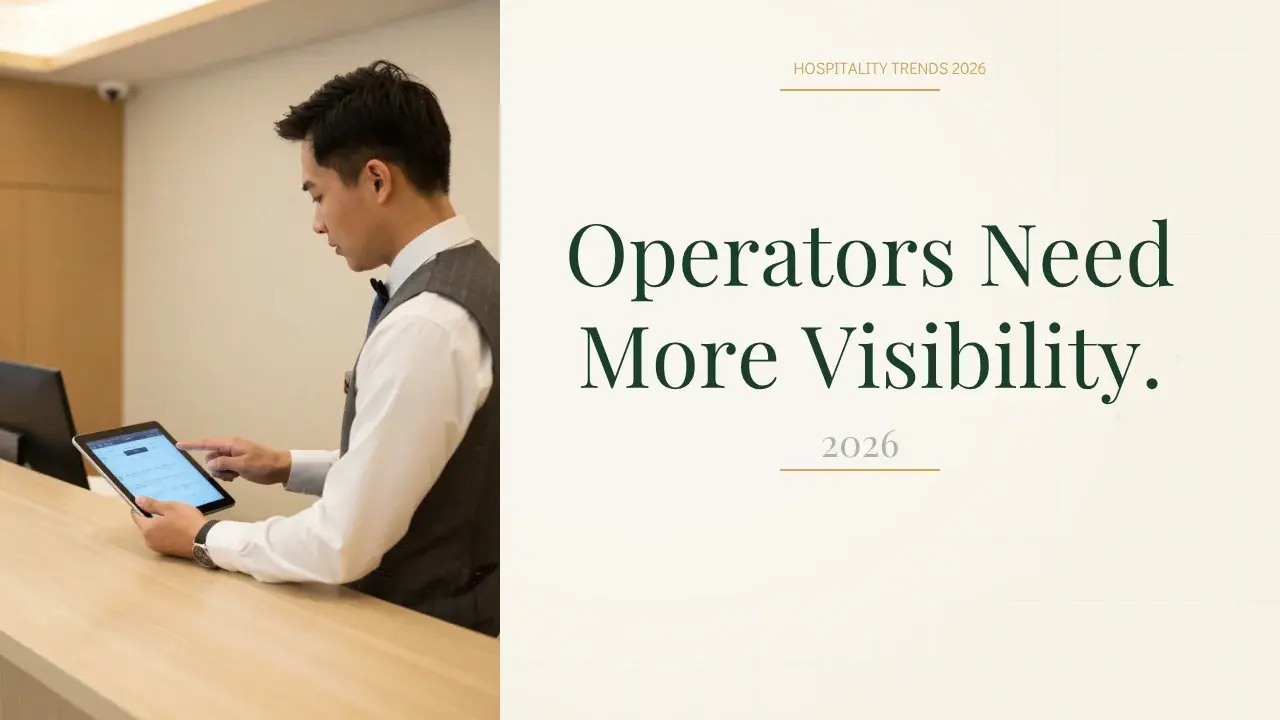
Hospitality enters 2026 with cautious optimism, but also with a more complex operating reality.
Demand has not disappeared. Luxury travel remains resilient in many markets. Major events are expected to lift hotel performance in key cities. New brands and collection concepts continue to expand. AI is moving from industry conversation to practical operational pressure.
But beneath these trends sits one challenge that cannot be ignored: hotels and hospitality groups are being asked to deliver more with teams that are harder to hire, more expensive to retain and increasingly difficult to plan around.
The industry is not only changing because guests are changing. It is changing because the workforce model behind hospitality is under pressure.
For operators, this means 2026 cannot be treated as another year of trend watching. It has to become a year of operational redesign. The winners will not be the brands that simply react to demand. They will be the ones that understand where demand is moving, what skills they need, how quickly they can hire and whether their teams are ready to deliver the experience guests now expect.
The five trends that matter most
Hotel Dive’s 2026 hospitality outlook highlights five forces shaping the sector: rising labor costs, AI-driven booking, brand expansion, luxury demand and major events. Each trend matters on its own. Together, they point toward a bigger shift.
Hospitality is becoming more fragmented, more technology-enabled and more labor-sensitive at the same time.
This creates pressure on owners, operators, HR teams and property leaders. Every decision now sits at the intersection of demand, cost, service quality and workforce availability.
1. Labor costs are no longer a back-office concern
Labor has always been one of hospitality’s largest costs. In 2026, it is also becoming one of hospitality’s biggest strategic risks.
AHLA expects U.S. hotel wages and benefits to approach 131 billion dollars in 2026, after reaching nearly 128 billion dollars in 2025. At the same time, the hotel workforce is projected to grow by more than 30,000 jobs, bringing direct hotel operations employment to around 2.2 million.
This is positive for employment, but difficult for operators. Higher wages, tighter margins, elevated insurance costs, utility pressure and property maintenance costs all make staffing decisions more consequential.
The question is no longer only whether a hotel can afford more people. The question is whether it can afford poor hiring decisions.
A weak hire in hospitality rarely affects one department in isolation. It affects training time, shift coverage, team morale, guest experience, manager workload and turnover risk. When labor costs rise, hiring accuracy matters more. Every unsuitable application, slow screening process and unclear candidate profile becomes more expensive.
This is why workforce visibility is becoming a margin issue. Hotels need to know who is available, who is qualified, who fits a specific service environment and where each candidate is most likely to succeed.
2. AI will reshape discovery, but not remove the need for human service
AI is moving into travel planning faster than many hotel operators expected.
PwC’s 2025 research found that 76 percent of millennials said they were likely to use AI for travel recommendations. A smaller share said they would use AI to book travel, which suggests that AI is already influencing discovery before it fully owns the transaction.
For hotels, this matters because guest discovery may no longer start with a search box, an online travel agency or a brand website. Increasingly, it may start with a question to an AI assistant: where should I stay, which hotel fits my trip, what property is best for my family, my budget or my event?
That shift affects distribution, content strategy and brand visibility. But it also affects operations.
If AI changes how guests choose hotels, it will also change what hotels must deliver. Guests will arrive with more specific expectations, more personalized itineraries and higher confidence that a property was chosen for their exact needs. Service teams will need to respond with consistency, speed and human judgment.
The industry should be careful not to confuse AI adoption with automation alone. In hospitality, AI should remove friction, not remove hospitality. The goal is not to replace service teams. The goal is to help them make better decisions, reduce repetitive work and focus more time on the guest moments that matter.
That same logic applies to hiring. AI can support screening, matching, ranking, communication and onboarding. But the final advantage remains human: empathy, judgment, leadership and service culture.
3. Luxury demand is strong, but talent expectations rise with it
Luxury continues to shape hospitality performance. High-net-worth travelers remain important demand drivers, and ultra-luxury properties are more insulated from price sensitivity than many other segments.
But luxury demand does not only increase revenue potential. It increases service expectations.
A luxury guest does not simply expect a room, restaurant or spa. They expect confidence, discretion, emotional intelligence, personalization, timing, product knowledge and problem solving. These qualities are not easily captured by a CV.
As luxury grows, talent selection becomes more important. The right candidate is not always the person with the longest experience. It may be the person with the strongest service instinct, the best communication style, the highest adaptability or the clearest motivation to build a hospitality career.
For luxury employers, this makes the hiring process a brand experience. A slow, unclear or generic recruitment journey weakens employer appeal. A professional, fast and human process reinforces the standards that luxury hospitality claims to represent.
The luxury segment cannot scale experience without scaling talent quality. That requires better candidate visibility, stronger screening and clearer development pathways after hiring.
4. Brand expansion increases complexity for owners and teams
Hotel groups continue to launch and expand collection brands, lifestyle concepts and conversion-friendly flags. This creates opportunities for owners, especially in markets where new construction is difficult and independent properties want access to distribution, loyalty and brand systems.
But brand expansion also creates operational complexity.
Different brands need different service styles. A lifestyle hotel, luxury resort, extended-stay property, boutique conversion and events-focused city hotel may all sit under the same corporate group, but they cannot be staffed in exactly the same way.
This is where traditional hiring systems begin to fail. They treat roles as generic. Hospitality is not generic.
The same job title can mean something completely different across properties. A front office agent in an ultra-luxury resort needs different behaviors from one in a high-volume airport hotel. A restaurant manager in a lifestyle brand may need a stronger community and concept-building mindset than one in a classic fine dining environment.
As brand portfolios grow, employers need a more detailed view of skills, personality, mobility, language ability, experience type and career goals. They also need to understand where talent can move internally before looking externally.
Brand growth without workforce intelligence risks creating more hiring noise, not more operational strength.
5. Major events will expose operational gaps
Major events such as the FIFA World Cup and America250 are expected to lift demand in selected cities and markets. For hotels, these moments can create short-term performance upside, but they also test operational readiness.
Events concentrate pressure. Occupancy rises. Guest expectations rise. Food and beverage demand rises. Scheduling becomes tighter. Temporary staffing may increase. Mistakes become more visible.
For operators, the risk is assuming that demand alone creates success. It does not.
Hotels need teams that can handle pace, service intensity and guest complexity. They need managers who can adapt. They need hiring pipelines that are built before the pressure arrives, not after shifts are already uncovered.
A major event is not only a revenue opportunity. It is a workforce stress test.
What must change
Hospitality needs to move from reactive hiring to workforce intelligence
The common thread across 2026 trends is not just demand. It is visibility.
Operators need visibility into guests, markets, channels and pricing. But they also need visibility into people: applicants, employees, internal mobility, skills, gaps, hiring speed, retention risk and employer attractiveness.
Too many hospitality employers still operate with fragmented hiring processes. Applications sit in inboxes or disconnected systems. CVs are reviewed manually. Candidate quality is judged inconsistently. Hiring managers lack structured information. Internal talent is overlooked. Onboarding starts from zero.
That model is no longer fit for the pace of the industry.
Hiring should become faster, but not less human
Speed matters because strong candidates do not wait. But speed alone is not enough.
Hospitality employers need hiring processes that are faster, clearer and more precise. This means structured candidate profiles, better skill mapping, mobile-first applications, shorter screening cycles, transparent communication and role-specific matching.
The best systems will not replace hospitality judgment. They will support it.
A hiring manager should spend less time sorting unsuitable applications and more time understanding the candidates who could actually succeed. HR teams should have a clearer view of the talent pipeline. Candidates should feel seen earlier in the process.
Employer attractiveness has to be managed like a performance metric
In a market where talent is scarce and expectations are rising, employer attractiveness cannot be left to brand reputation alone.
Candidates are looking for clearer career pathways, better communication, flexibility, training, recognition and workplaces where they can see a future. These expectations are especially important for younger talent, who often compare hospitality with industries that offer faster hiring, clearer flexibility and more predictable working models.
Hospitality cannot only ask why candidates are not applying. It has to ask what candidates experience when they do.
That includes the job post, the application, the response time, the interview, the onboarding and the first weeks of work. Each step either strengthens or weakens the employer brand.
Technology should help hospitality become more human, not less
The danger in 2026 is that hospitality treats AI as a shortcut rather than a tool.
AI can help operators screen faster, forecast staffing needs, improve candidate matching, personalize guest journeys and reduce repetitive administration. But hospitality remains a people industry. Guests remember the human moment, not the backend automation.
The best use of technology is to create more space for better human decisions.
That is the real opportunity for hospitality employers: use technology to reduce noise, improve visibility and make better decisions about people.
The real trend for 2026
Labor costs, AI discovery, luxury demand, brand expansion and major events may look like separate trends. They are not.
They are all signals that hospitality is becoming more demanding to operate and more difficult to staff well.
The future will not belong only to the brands with the strongest guest-facing technology or the biggest development pipeline. It will belong to the operators that can connect market demand with workforce readiness.
Hotels can no longer afford to hire in circles, lose strong candidates to slow processes or rely on CVs that do not show real service fit.
In 2026, hospitality needs better visibility across the full talent funnel: sourcing, screening, ranking, interviewing, onboarding and internal mobility.
The industry has always said that people are its greatest asset. The difference now is that people need to be managed with the same strategic clarity as revenue, distribution and brand growth.
That is the trend hospitality cannot afford to miss.
Sources
Hotel Dive. Top 5 hospitality industry trends to watch in 2026. January 7, 2026. https://www.hoteldive.com/news/top-hospitality-industry-trends-2026/808959/
American Hotel & Lodging Association. AHLA releases 2026 State of The Industry. January 27, 2026. https://www.ahla.com/news/ahla-releases-2026-state-industry
Deloitte. 2026 Travel Industry Outlook. February 5, 2026. https://www.deloitte.com/us/en/insights/industry/transportation/travel-hospitality-industry-outlook.html
PwC. Holiday Outlook 2025. September 3, 2025. https://www.pwc.com/us/en/industries/consumer-markets/library/holiday-outlook-trends.html
World Travel & Tourism Council. WTTC Report Shows Travel & Tourism Set to Support 91MN New Jobs by 2035. September 30, 2025. https://wttc.org/news/wttc-report-shows-travel-and-tourism-set-to-support-91mn-new-jobs-by-2035
Hotel Dive. Hospitality industry could face 8.6M workforce shortfall by 2035: WTTC. October 9, 2025. https://www.hoteldive.com/news/hospitality-industry-workforce-shortfall-wttc/802451/